Does Your Cat Trust You? 4 Everyday Behaviors That Reveal the Answer
Quick Answer: A cat rarely fakes trust. When a cat feels safe with someone, it shows up in small, repeated actions rather than dramatic displays, and four behaviors give the clearest answer of all.
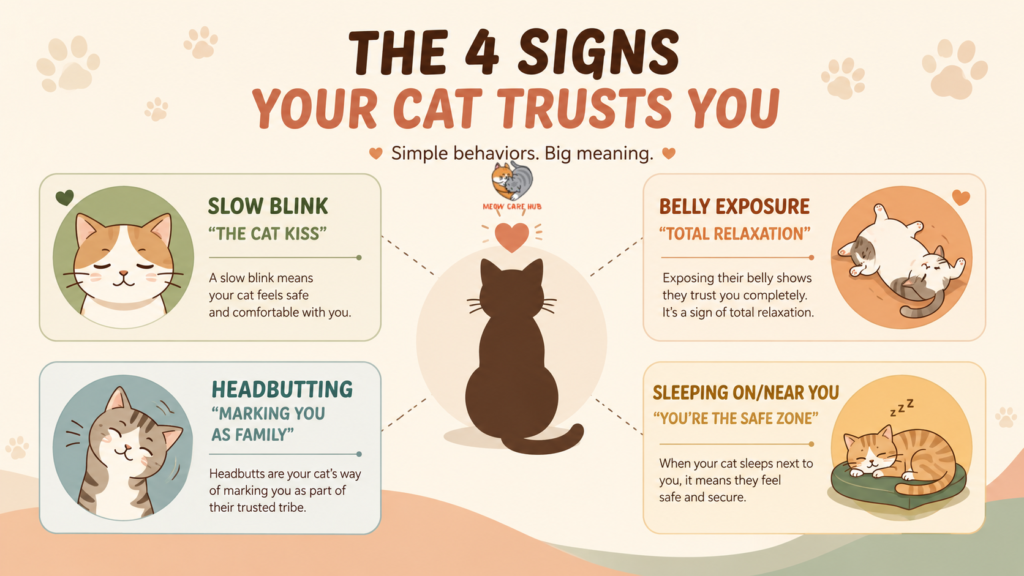
- Slow blinking works like a feline kiss, a sign the cat feels calm enough to lower its guard.
- Showing the belly means the cat feels relaxed enough to expose its most vulnerable spot, not necessarily an invitation to touch it.
- Headbutting deposits the cat’s own scent, a way of marking a person as family.
- Sleeping on or near someone means that person has been chosen as the safe zone.
The Misconception Most Cat Owners Fall Into
Plenty of cat parents grow up around dogs first, and dogs make affection loud and obvious. Tails wag, tongues come out, whole bodies wiggle at the sight of a favorite human. So when a cat just sits there, blinking slowly from across the room, it’s easy to read that as indifference.
It isn’t. Feline behavior researchers have long noted that cats communicate primarily through subtle body language rather than vocalization or dramatic gestures, and a cat that has bonded with someone shows it constantly, just quietly. The four behaviors below are the ones worth watching for, because a cat genuinely does not offer them to just anyone.
Think your cat loves you? Wait until you discover the 4 subtle trust tests they give only to the people they trust most:
What Does It Mean When a Cat Trusts You?
A cat that trusts a person will voluntarily lower its own defenses around that person, things like exposing the belly, holding eye contact through a slow blink, or falling asleep within arm’s reach. Cats that feel wary or unsure tend to keep those same defenses up, watching from a distance instead. Trust, in cat terms, looks like a gradual willingness to be vulnerable.
Why Cats Don’t Show Trust to Everyone
Cats evolved as both predator and prey, which wired them to stay alert by default. A cat left alone outdoors has to watch for threats constantly, so any behavior that lowers that guard carries real risk in the wild. When a house cat still chooses to do it around a specific person, that choice means something. It isn’t aloofness. It’s a small act of risk that the cat has decided is safe to take.
1. The Slow Blink: Your Cat’s Way of Saying “I Trust You”
A slow blink happens when a cat looks directly at someone, then closes its eyes gradually and reopens them at an unhurried pace, sometimes repeating the motion two or three times in a row. This is often called the cat kiss, and it ranks among the clearest signals of comfort a cat can give. Closing the eyes for even a second removes a cat’s ability to watch for danger, so doing it on purpose, while looking right at a person, signals real ease.
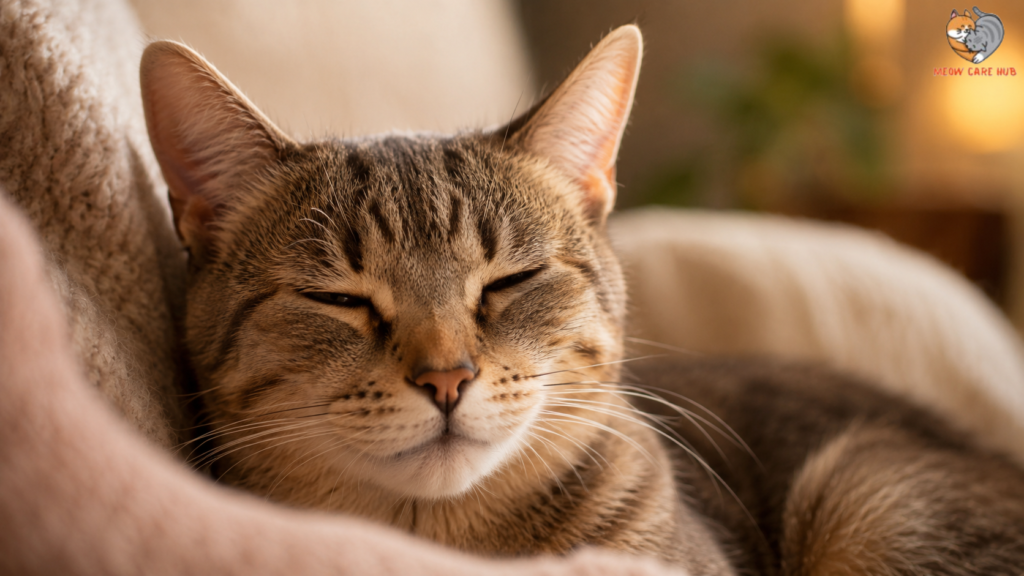
How to return a cat’s slow blink:
- Meet the cat’s gaze softly, without a hard stare.
- Close the eyes slowly, holding for a beat longer than a normal blink.
- Open them again at the same relaxed pace, then look away naturally rather than continuing to stare.
A cat that doesn’t do this every day isn’t necessarily withholding trust. Some cats are simply less visually expressive, especially older cats or those who came from rough starts before adoption. A single slow blink now and then still counts.
2. Why Does My Cat Show Me Their Belly?
A cat exposing its belly is showing that it feels fully relaxed, not asking for a belly rub. The stomach protects several vital organs, and lying with it exposed leaves a cat physically slower to react if something goes wrong. A cat only takes that risk in a spot it considers genuinely safe.
Reaching in for a rub anyway is one of the most common reasons cats scratch or bite otherwise affectionate owners. The gesture is a compliment, not an invitation. A better response is simply to acknowledge it, a soft word, a slow blink back, maybe a gentle scratch under the chin if the cat leans into that instead.
3. What Does It Mean When a Cat Headbutts You?
Headbutting, sometimes called bunting, comes from scent glands located around a cat’s cheeks, forehead, and chin. When a cat presses its head or face against a person, it transfers its own scent onto them, effectively marking that person as part of its territory and social group. Kittens learn the behavior early, bunting against littermates and their mother before ever directing it at a human.
A cat that headbutts regularly has folded that person into its sense of home. Leaning gently into the headbutt, rather than pulling away, reinforces the gesture and tends to bring on more of it over time. Readers who want a deeper look at how cats read and respond to human emotional cues, including the moments right after a mishap around the house, can find more detail in this piece on whether cats feel guilt or try to apologize, which covers many of these same reconnection behaviors.
4. Why Does My Cat Sleep on Me?
Sleep is when a cat is at its most defenseless, so choosing to nap on or beside a specific person is one of the strongest trust signals a cat can give. It combines two things at once: physical closeness and total vulnerability. A cat that curls up directly on a lap is making that statement loudly. A cat that sleeps just a few feet away, close enough to stay in the same room but not touching, is making a quieter version of the same point.
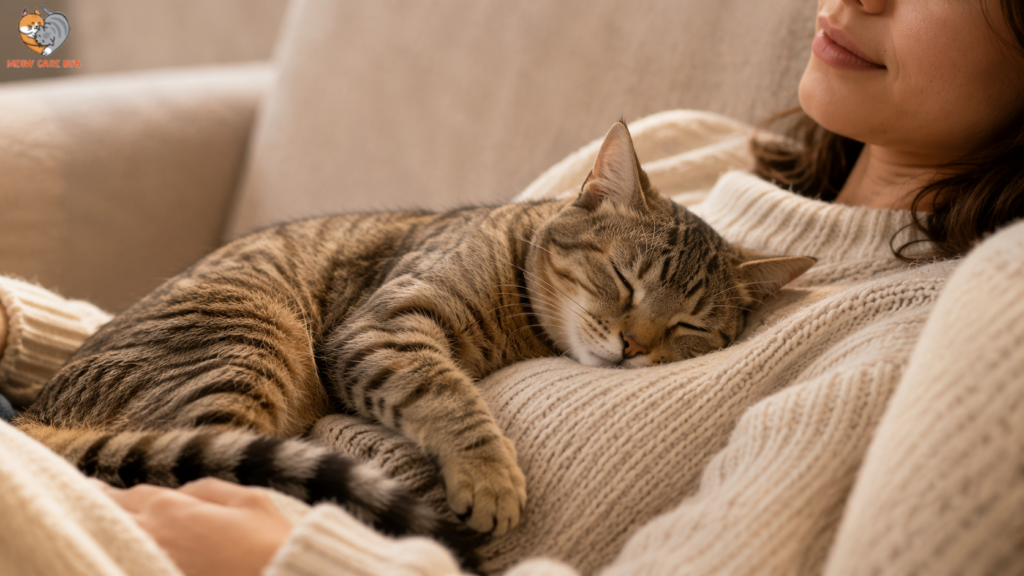
Both count. Not every cat is a lap cat, and that has more to do with individual personality than depth of feeling. Owners planning to be away from home for stretches at a time, whether for work or travel, often notice their cat’s sleeping habits shift toward more anxious patterns during that absence; a walkthrough on keeping a cat safe and settled while away covers how to keep that routine steady even when someone can’t physically be there.
Cat Trust Signals at a Glance
| Behavior | What It Looks Like | What It Means | How to Respond |
| Slow Blink | Eyes half close, then open slowly, often repeated | The cat feels calm, comfortable, and safe around you | Return a slow blink, then look away gently to reinforce trust |
| Belly Exposure | Rolls onto its back with its stomach exposed | A sign of complete relaxation and trust, not always an invitation for petting | Avoid rubbing the belly unless the cat clearly leans in or invites contact |
| Headbutting | Presses its head or cheek against you | Marks you with its scent, showing affection and treating you as part of its family | Lean in slightly and allow the cat to continue rubbing if it chooses |
| Sleeping on or Near You | Curls up on your lap or rests close beside you | Sees you as a safe and trusted companion | Stay still, let the cat settle comfortably, and avoid disturbing its rest |
Building More Trust Day to Day
None of these behaviors need to be forced. Trust with a cat tends to build through small, consistent choices rather than grand gestures: a predictable feeding schedule, letting the cat approach first instead of reaching for it, and paying attention to the early warning signs a cat gives before it feels overwhelmed, a swishing tail, flattened ears, a low growl. Respecting those cues actually speeds up the bond rather than slowing it down, because the cat learns that its boundaries get honored.
Cats also pick up more from tone and routine than most owners expect. For anyone curious about how much a cat actually understands beyond body language, this breakdown of commands and words cats secretly recognize is worth a look, and it pairs well with everything above.
The Bottom Line
Trust from a cat rarely announces itself. It shows up in the quiet decision to close its eyes for a second longer, to roll onto its back, to press its face against a hand, or to fall asleep close enough to touch. Anyone whose cat does even one of these regularly already holds a place that isn’t handed out freely.
For more everyday cat behavior explained in plain terms, along with practical care guidance for every stage of a cat’s life, browse the full library at Meow Care Hub.
Frequently Asked Questions
Look for repeated behaviors rather than a single moment: slow blinking during eye contact, a relaxed belly exposure, headbutting or cheek rubbing, and choosing to sleep on or near a person. Cats that trust someone also tend to keep their tail upright and approach without hesitation.
Sleeping directly on or against a person is often considered the strongest single signal, since sleep leaves a cat fully unguarded. That said, a genuine slow blink carries nearly the same weight, since it’s a deliberate act rather than something that happens passively.
Belly exposure communicates total relaxation, not an open invitation for a rub. The stomach protects sensitive organs, so most cats still react defensively if that area gets touched, even when they trust the person completely.
Cats form real, lasting bonds with their owners, but they express that bond through subtler cues rather than constant, visible enthusiasm. The underlying attachment can run just as deep even though the outward signs look completely different from a dog’s.
Some cats show trust mainly through other behaviors instead, like sleeping nearby, following from room to room, or headbutting. A cat that skips the slow blink but does two or three of the other signals regularly is still showing genuine trust in its own way.