Adopting a Senior Cat: What Nobody Tells You (And Why It Might Be the Best Decision You Ever Make)

Most people walk into shelters and choose kittens without a second thought, but the quiet senior cats waiting in the background often make the most rewarding companions. This piece gently challenges that instinct, showing how older cats come with calm personalities, established habits, and a deep capacity for connection. It also breaks down the realities, from health care to home setup, with practical, reassuring advice. Adopting a senior cat isn’t just an act of kindness, it’s often the perfect match for real life. Sometimes, the cat who’s been waiting the longest turns out to be exactly the one you needed.
Walk into almost any shelter and watch what happens. People head straight for the kittens. Every single time.
It’s understandable. Kittens are irresistible, small, playful, full of potential. The idea of raising one from the beginning has a real emotional pull. But that preference has a direct and serious consequence that most people never think about: adult cats wait months. Senior cats, in many shelters, never leave at all. And when space runs low, they’re the first to face euthanasia.
That’s the reality nobody puts in the adoption brochure.
Here’s what else they leave out: the cat sitting quietly at the back of that room, the 9-year-old, the 11-year-old, the one who’s been there the longest, is frequently the most rewarding adoption anyone will ever make. Cats now routinely live into their late teens and even early 20s with proper care. An 8-year-old cat can easily have a decade ahead. And unlike a kitten, whose personality doesn’t fully settle until after year one, a senior cat is already exactly who they’re going to be.
That’s not a limitation. That’s a gift.
What the Adoption Brochures Don’t Tell You
The Advantages That Catch Most People Off Guard
With a kitten, there is always an element of mystery. A calm kitten can turn into a tornado at eight months. You won’t really know what cat you have until they’re well past their first birthday.
With a senior cat, that uncertainty is gone entirely. Shelter staff can give an accurate character profile on day one, this one is a lap cat, that one needs a quiet household. No surprises, no “wait and see.” Just a cat you can choose with genuine confidence.
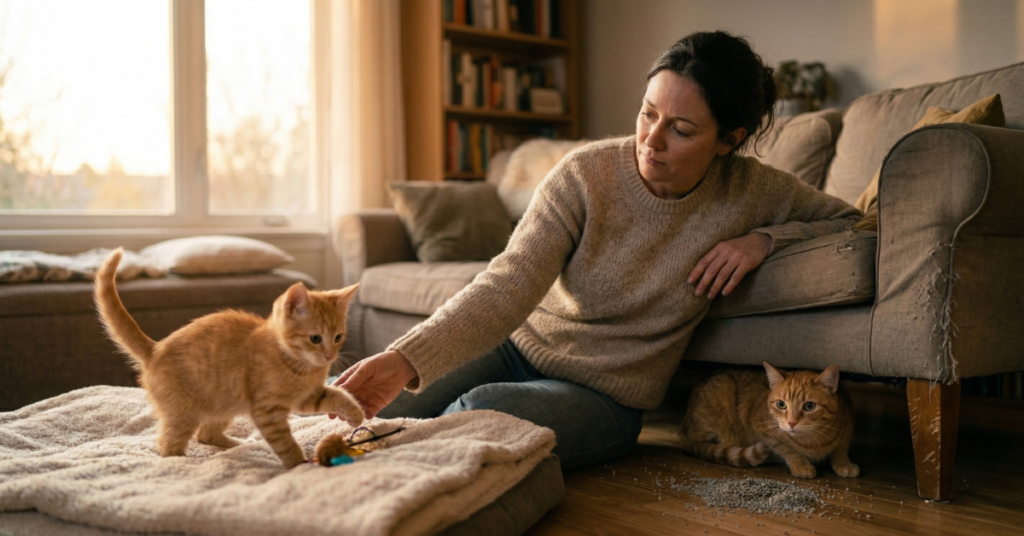
The destructive phase is also completely behind them. The curtain climbing, cable biting, furniture scratching, 3am wall-of-death enactments, all ancient history. Their habits are established and their energy is settled.
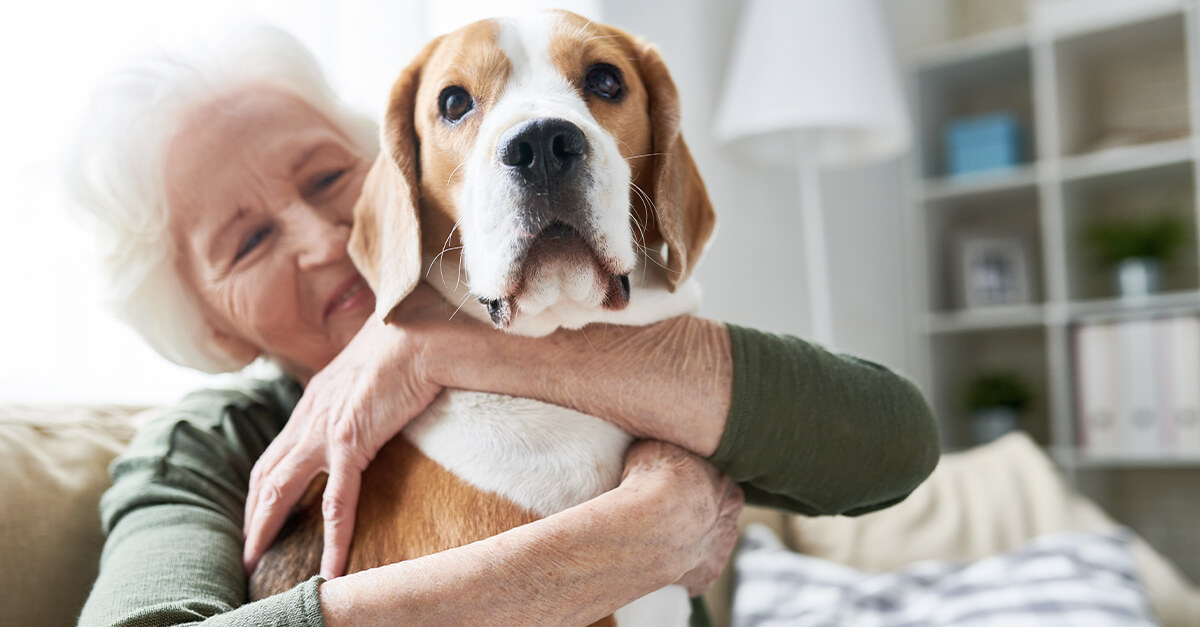
And then there’s the companionship itself. Senior cats want warmth, closeness, and peace. They are not demanding constant entertainment, they want to be near you. For anyone who works from home, lives alone, or simply wants a calm presence, a senior cat is often a far better fit than people expect.
The initial costs are lower too. Many shelters waive or significantly reduce adoption fees for seniors. Most are already spayed, neutered, and fully vaccinated. The expensive first-year vet series that kittens require simply is not part of the equation.
The Real Benefits of Adopting an Older Cat
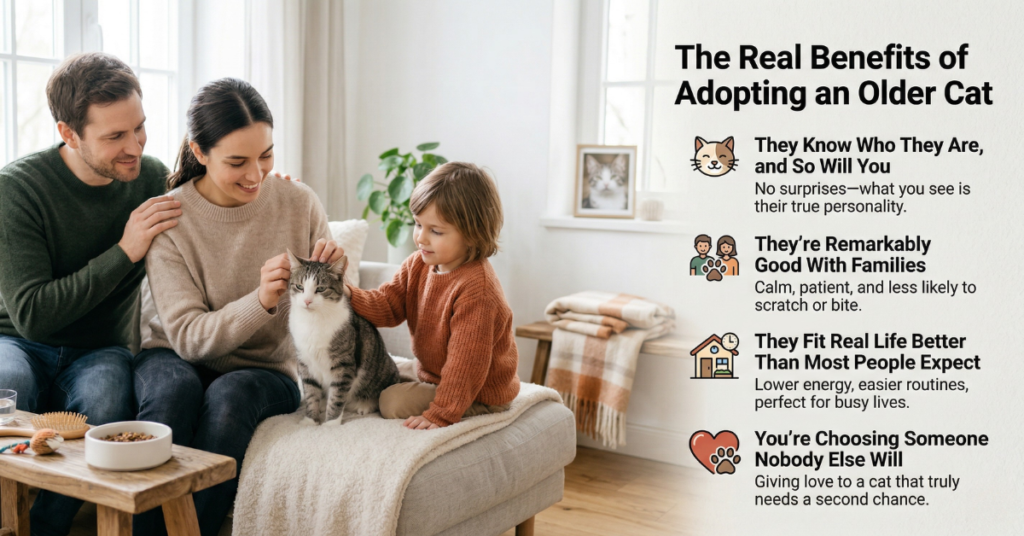
1. They Know Who They Are, and So Will You
This is the advantage that surprises people most. Matching a cat to a specific household, young children, other pets, a busy lifestyle, a quiet apartment, is genuinely easier when the personality is already fully formed. No guesswork. What you see in that shelter kennel is exactly who is coming home with you.
2. They’re Remarkably Good With Families
Senior cats are notably more patient with small children than kittens are. Kittens react badly to tail-grabbing, sudden movement, and the enthusiastic handling small children are famous for. Older cats handle those indignities with a calm grace that kittens simply haven’t developed yet.
3. They Fit Real Life Better Than Most People Expect
Busy professionals, people living alone, anyone in a smaller apartment, the senior cat profile fits these situations beautifully. They’re relaxed about being left alone, don’t need constant stimulation, and settle right back into your company the moment you’re home. For a lot of people, that quiet, steady presence turns out to be exactly what they needed.
4. You’re Choosing Someone Nobody Else Will
This is where senior cat adoption moves beyond the practical. It is a conscious decision to choose an animal that most people walk past, to say their remaining years matter. Many people who have done it describe the bond that followed as the most meaningful connection they ever had with an animal. There is something about giving a cat their last chapter that stays with people for a very long time.
Senior Cat Health- What to Watch For and How to Stay Ahead
Most age-related conditions in cats are manageable. The key is knowing what to look for and catching things early, which is exactly why the six-month vet schedule exists.
Schedule a vet visit within the first week of adoption to establish a baseline physical exam and lab work. Even if the shelter provided health records, a fresh baseline is essential for comparison as time passes.
Here are the conditions that come up most frequently in senior cats, and what actually helps:
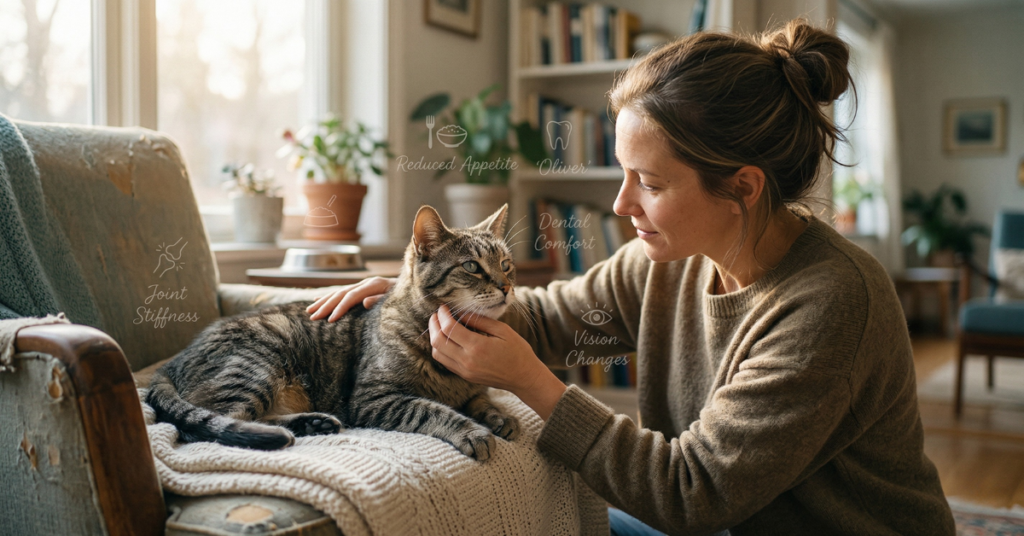
- Arthritis shows up as hesitation before jumping, noticeable stiffness, or matted fur on the back, because reaching to groom there has become painful. Ramps and pet stairs, a heated bed, and a low-sided litter box that doesn’t require climbing make a meaningful difference.
- Kidney disease typically presents as increased thirst and more frequent urination. Fresh water should always be accessible, a water fountain encourages drinking, and specialized diets are often prescribed once a diagnosis is confirmed.
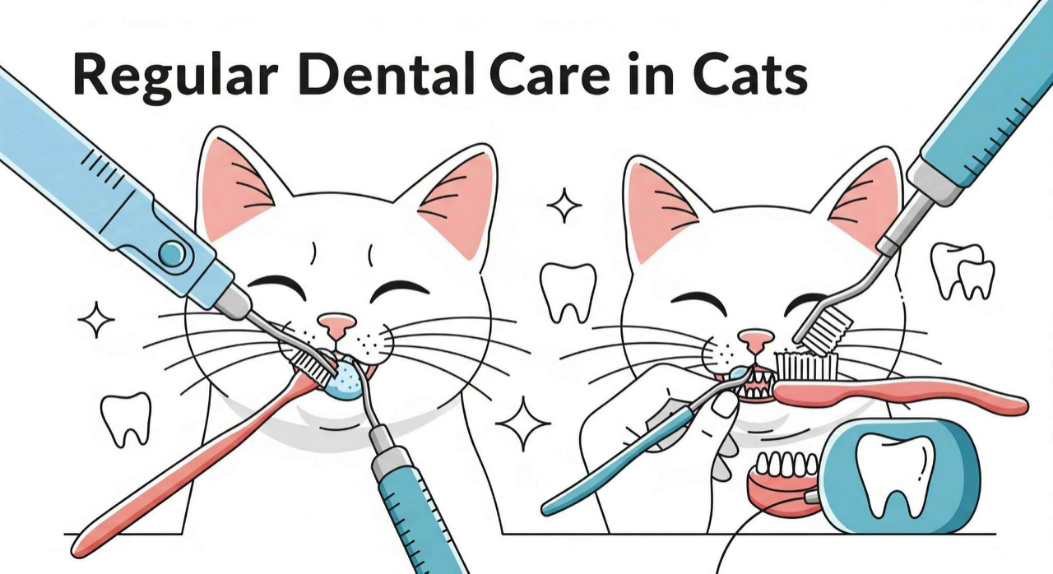
- Dental disease is one of the most underestimated senior cat health issues. Bad breath, hesitation while eating, and pawing at the mouth are the signs to watch. Regular dental exams and at-home brushing where the cat will tolerate it prevent small problems from becoming major ones.
- Hyperthyroidism weight loss despite a healthy or increased appetite, sometimes paired with unusual hyperactivity, is one of the more common senior cat diagnoses and one of the most manageable. Medication and specialized diets both work well.
- Cognitive decline looks like nighttime vocalization, wandering, or visible disorientation. Consistent daily routine is the most effective management tool. Nightlights throughout the home, particularly on the path to the litter box, help cats with fading vision navigate safely.
Setting Up Home for a Senior Cat
Before the cat arrives, run through this checklist. It takes an afternoon and makes an enormous difference:
Place pet stairs or ramps next to any bed or sofa the cat will want to reach. Switch to a low-sided litter box, standard high-walled boxes are genuinely painful for arthritic cats to climb into. Set up sleeping spots at floor or low furniture level in multiple rooms. Add nightlights in hallways and on the path to the litter box. Keep furniture placement consistent, changes disorient cats with any degree of cognitive decline. Put water bowls in more than one location. Get the cat microchipped if the shelter hasn’t already done it, and set up pet insurance before the first vet visit if at all possible.
The Fears Worth Addressing Honestly
“They’ll die soon and it will break my heart.”
Yes, and that day will come with any pet, at any age. An 8-year-old cat can easily have a decade of good life ahead. If the time turns out to be shorter, those years will be genuinely better because of the decision to adopt. The grief of losing a pet is real regardless of when it comes. The quiet regret of leaving one behind when a home could have been offered, that has its own weight too.
“They’ll have expensive health problems.”
Possibly, though most chronic conditions are manageable with consistent veterinary care. Pet insurance taken out at adoption significantly reduces financial uncertainty. The more complete question is whether the potential for vet bills outweighs everything else on this list, and for most people who’ve actually made this decision, it doesn’t come close.
The Cat You Need Might Be the One Who’s Been Waiting the Longest
Kittens are adorable. Senior cats are complete.
They already know who they are. They already know how to love. They’ve already lived enough life to be patient, settled, and genuinely grateful for a warm home and a person who chose them. They’re just waiting for someone to walk to the back of the room and actually look.
Next time you’re in a shelter, try it. Walk past the kittens. Find the one who’s been there the longest. Sit with them for a few minutes.
That might be the cat you needed all along.
Explore more compassionate, practical cat care guidance at Meow Care Hub.
Frequently Asked Questions About Adopting a Senior Cat
Most veterinarians classify cats as senior from around 10 to 11 years old, though some guidelines begin at 7. In shelter contexts, any cat over 5 or 6 tends to get overlooked in favor of kittens, and every one of them can make an exceptional companion with good years still ahead.
Many owners find the opposite is true. Senior cats, particularly those who have lost a home or spent time in a shelter, often bond deeply and quickly. The connection feels mutual in a way that’s harder to describe than it is to experience. Quieter than kitten energy, but no less real.
Initial costs are often lower, many shelters waive fees entirely for seniors, and most arrive already spayed, neutered, and vaccinated. Ongoing care can run higher due to more frequent vet visits and age-related conditions. Pet insurance taken out at adoption is the most practical way to manage that uncertainty.
Schedule a vet visit within the first week for a baseline exam and lab work. Before arrival, set up a low-sided litter box, ramps where needed, multiple sleeping spots, water in several locations, and nightlights if vision may be a concern. Then give the cat time. Some settle within hours. Others need a few quiet days to understand that this place is theirs now.
Generally yes. Senior cats handle children with more patience than kittens do. With other pets, a slow and structured introduction is always recommended. Most senior cats adapt well given a calm environment and enough time to adjust on their own terms.
This article is intended for informational purposes only. Always consult a licensed veterinarian for health advice specific to your cat.